
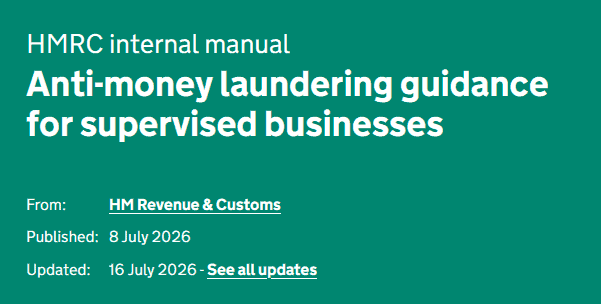
HMRC’s new Anti-Money Laundering Guidance for Supervised Businesses, published in July 2026, is much more than a restatement of the Money Laundering Regulations or previous HMRC AML guidance. It provides the clearest indication yet of what HMRC expects to see when assessing an accountancy practice’s AML compliance.
Having reviewed the new guidance, six themes from HMRC stand out for accountants, bookkeepers and tax advisers.
1. The Firm-Wide Risk Assessment Is Now the Centre of the AML Framework
Many firms still treat the Firm-Wide Risk Assessment (FWRA) as a document that just sits at the front of the AML manual and is updated once a year.
HMRC’s guidance takes a different view.
The FWRA is presented as the foundation of the firm’s entire AML framework. In HMRC’s view Policies, Controls and Procedures (PC+Ps) should flow directly from the risks identified in the risk assessment.
The guidance also reinforces that firm-wide risk assessments must cover not only money laundering and terrorist financing, but also proliferation financing.
2. Generic Templates Are Increasingly Difficult to Defend
Most firms use templates when preparing AML documentation. There is nothing wrong with that.
However, HMRC explicitly states that generic risk assessments must be adapted to reflect the firm’s own circumstances.
This is consistent with a trend that many practitioners have already noticed during compliance reviews. The issue is not whether a template is used, but whether it genuinely reflects the firm’s clients, the firm’s services, the firm’s delivery and communication channels and the firm’s geographical exposure. Each firm is unique.
The message is simple: if your risk assessment could be exchanged with another firm’s without anyone noticing, it probably needs more work.
3. Historic AML Documents Need to Be Retained
One of the more interesting points in the new guidance concerns document retention.
HMRC now states that previous versions of both FWRAs and PC+Ps should be retained for at least five years.
For many firms this will require a change of approach. Historically, some practices simply overwrote earlier versions when updating AML documentation. The guidance makes it clear that HMRC expects firms to be able to demonstrate how their AML framework has evolved over time.
In practical terms, maintaining version-controlled copies of AML documentation is likely to become increasingly important.
4. Source of Funds and Source of Wealth Are Not the Same Thing
Perhaps the most useful new section of the guidance is HMRC’s explanation of Source of Funds and Source of Wealth.
The distinction should be familiar to compliance professionals, but HMRC provides unusually clear guidance on the subject.
Source of Funds relates to the specific funds being used for a transaction. A client’s bank account is not, in itself, a source of funds. Firms should understand how the money was generated, whether through employment, business profits, inheritance, investments or some other legitimate source.
Source of Wealth is much broader. It concerns the origin of the individual’s overall wealth and asks a more fundamental question: how did this person accumulate the assets they now possess?
The guidance repeatedly emphasises that obtaining documents is not enough. Firms must assess whether the explanation is plausible and whether the available evidence supports the client’s explanations.
That emphasis on professional judgement is perhaps more important than any specific list of documents.
5. HMRC Is Paying More Attention to Staff Screening
The guidance also provides the strongest indication yet of HMRC’s expectations regarding employee screening.
For larger or more complex businesses, HMRC expects AML procedures to address matters such as:
- right-to-work checks;
- Disclosure and Barring Service basic checks;
- employee notification of relevant convictions;
- some assessment of competence and capability.
While these expectations are linked to existing regulatory requirements, the guidance goes further than previous HMRC publications in explaining what effective screening might look like in practice.
Firms reviewing their MLR 2017 Regulation 21 procedures should therefore pay particular attention to this section.
6. Supply Chains Have Emerged as a New Risk Area
One of the themes running through the guidance is the increasing focus on supply chains and intermediaries.
HMRC is clearly concerned about situations where work reaches a firm through multiple parties, creating distance from the ultimate client.
For accountants, this could include referrals from:
- other accountancy practices;
- bookkeepers;
- payroll bureaux;
- TCSPs;
- overseas outsourcers.
HMRC’s concern is that elongated supply chains can obscure beneficial ownership, control and the identity of the true client.
Many firms will already carry out due diligence on introduced clients. The new guidance suggests that HMRC expects practices to think more carefully about whether intermediary relationships create additional risks and how those risks are managed.
Final Thoughts
HMRC appears less interested in whether a firm possesses AML documents and more interested in whether those documents demonstrate genuine understanding, informed judgement and effective implementation.
The key themes from this HMRC AML guidance are:
- risk assessments must drive AML controls;
- documentation must be tailored to the business;
- historic AML records should be retained;
- source of funds and wealth require meaningful analysis;
- staff screening matters;
- supply chains deserve closer scrutiny.
For many accountancy practices, the next review of the Firm-Wide Risk Assessment and AML Policies, Controls and Procedures will be an ideal opportunity to assess whether those expectations are being met.
If your firm’s AML compliance is incomplete, out of date, or has never been properly documented, get in touch now using the link below and we can work together to fix this. The hardest part is getting started.
