
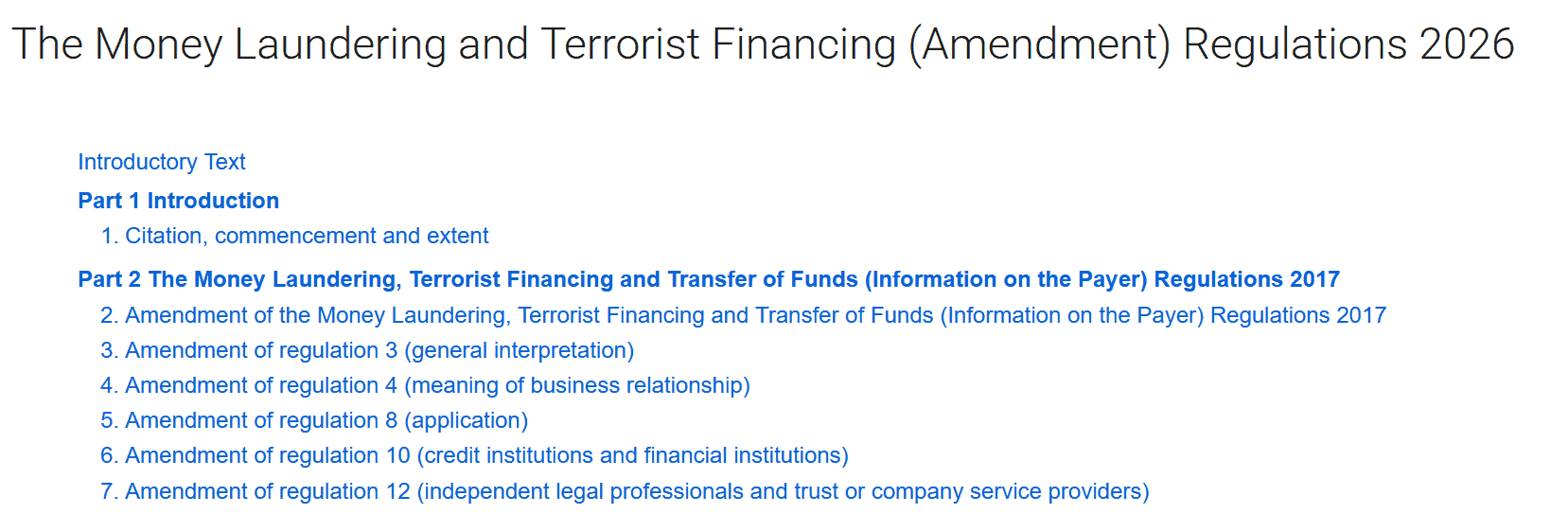
This month’s blog will deal briefly with updates on three key topics – amendments to MLR 2017, the implementation by Companies House of the changes being made under the Economic Crime and Corporate Transparency Act 2023, and the transfer of AML supervision of accountants, bookkeepers, tax advisers and TCSPs to the FCA.
Amendments to MLR 2017
A final draft Statutory Instrument of the latest amendments has now been published here. The amendments are lengthy but most of these amendments will not trouble the vast majority of UK accountants, bookkeepers, tax advisers and TCSPs.
Currency amounts denominated in Euros in the MLR 2017 will be amended to amounts in sterling – generally on a one-to-one basis, so for example 10,000 euros will become £10,000.
In the Regulations the expression “complex or unusually large” will be replaced by “unusually complex or unusually large in each case given the nature of the transaction”. This serves to clarify that “complex” and “large” must be viewed in context.
There is a new body of regulation relating to those who engage in transactions in crypto currencies by way of business, and new regulations dealing with pooled client accounts.
The amendments are expected to come into effect in the Summer of 2026, except for the crypto currency changes which will come into effect in 2027.
These amendments do not affect the AML supervision of accountants, bookkeepers, tax advisers and TCSPs.
Companies House changes
Companies House is proceeding with the progressive ID verification of company directors and PSCs.
This commenced on 18 November 2025 and is scheduled to be completed over 12 months.
The latest figures I have – dated 20 March 2026 – are that there were then 9,161,548 directorships on the Companies House Register of which 2,529,533 had verified IDs, which is 27.6%. However there were 1,116,556 directorship IDs overdue for verification (meaning that the due date for verification of those directorships had passed).
There were 6,500,350 PSCships on the Register of which 1,233,660 had verified IDs, which is 19.0%. There were 829,811 PSCship IDs overdue for verification.
At 20 March 2026 we were just over four months through the intended 12 month period so, if matters were on track, we might expect one-third of IDs to have been verified. Clearly less than one-third have completed verification.
The numbers overdue keep rising, indicating matters are falling further behind.
There are also a significant number of individuals who have verified their ID as director but not verified their ID as PSC of the same company. This indicates a failure to understand the process.
It now seems likely that the requirement, originally scheduled for Spring 2026, for presenters of documents to be ACSPs or have a verified ID, will be postponed until 2027.
AML Supervision transfer to the FCA
The government announced in October 2025 that it had decided that AML supervision for accountants, bookkeepers and trust or corporate service providers (TCSPs) should be undertaken by the Financial Conduct Authority (the FCA) rather than continuing with the existing supervision by the professional bodies and HMRC. But the timing for this change is unclear.
The change requires a new Act of Parliament to set out the duties of the FCA and provide it with the powers it will need. The next session of Parliament will begin with the King’s Speech on 13 May 2026. The necessary Act may be mentioned in the King’s Speech and a Parliamentary Bill might be published soon afterwards – or the process may be more drawn out.
The FCA currently regulates about 40,000 entities and that number is expected to be more than doubled under the new arrangements. The FCA recently published their financial budget for the year to 31 March 2027 and this does not show any very significant increase in expected expenditure. The inference is that the FCA do not anticipate the AML supervision change to take effect until after March 2027.
The UK is due a mutual evaluation inspection visit from the FATF in October 2027 and it seems likely that the government will at least want to have the legislation on the statute book by then. However there will be work to be done after the legislation is in place, including the publication of new guidance for the accountancy sector to replace the current guidance published by the accountancy bodies.
So it would be fair to say that there is a lot which we do not yet know about the new arrangements.
If you are concerned that your firm’s AML compliance is inadequate, or even non-existent, get in touch now using the link below and we can work together to fix this. The hardest part is getting started.
